
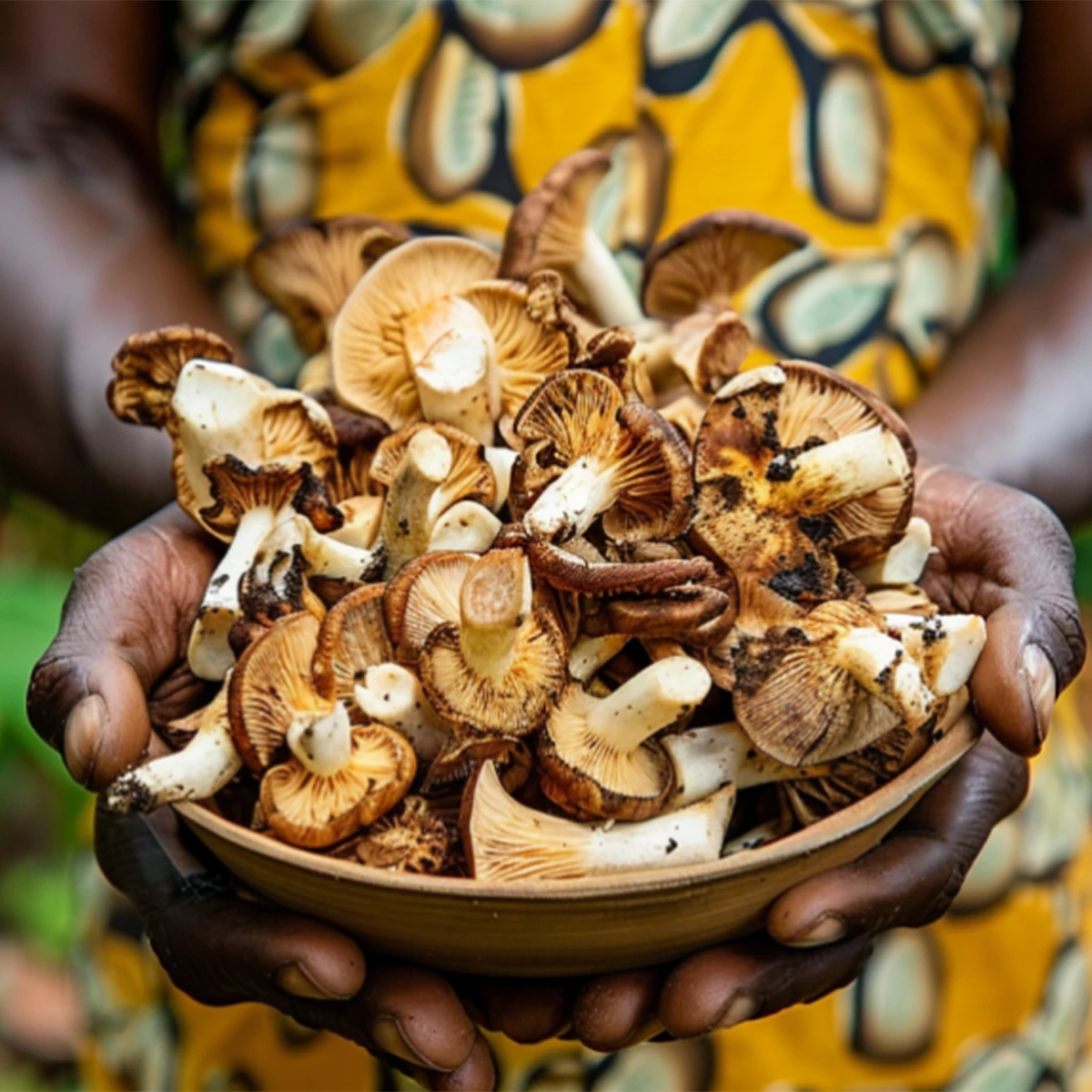
When we think of gourmet mushrooms, we typically think of the classics: oyster mushrooms (Pleurotus ostreatus) and shiitake (Lentinula edobes), or perhaps the lesser-known but equally delicious chestnut mushrooms (Pholiota adiposa). Beyond this familiar lineup, however, lies a largely untapped world of wild mushrooms indigenous to the African continent–mushrooms like Lentinus squarrosulus and Pleurotus tuber-regium (known colloquially as the “king tuber mushroom”). For generations, these mushrooms have been harvested from forests, farmland, and termite mounds for use as food and medicine, and a wealth of deep history surrounds each species.
Commercial markets for gourmet and medicinal mushrooms are exploding all over Africa, and wild harvesters are barely able to keep up with the demand. Fortunately for the fungi lovers, the use of home and industrial-scale cultivation is quickly catching on in countries like Nigeria and Kenya. A recent scientific review pulled together decades of scattered research and traditional knowledge to reveal an exciting, if somewhat daunting picture of the future of indigenous African mushroom cultivation.
Current State of Mushroom Harvesting and Wild Fungi Symbiosis
Unlike in Europe, Asia, and the United States, where mushroom spores are widely available and mushroom cultivation has been industrialized for over a century, much of sub-Saharan Africa still relies on wild harvesting to meet their fungal demands. During the rainy season, rural communities descend into forests and fields to collect edible species they’ve learned to recognize over generations. These pickers are the lifeblood of the gourmet mushroom industry, and without them a vital food source wouldn’t be accessible to most of Africa.
Across the continent, mushrooms grow in all manner of environments. Life-sustaining and delectable fungi can be found on humid forest floors, in decaying wood piles, and sprouting out of fallen trees. A particularly strong symbiotic relationship exists between mushrooms and termites, with termite mounds serving as prime locales for mushroom pickers. Species like Termitomyces are deeply linked to termite mounds, forming complex biological partnerships that make them both fascinating and challenging to cultivate. Others, such as Pleurotus tuber-regium or Lentinus squarrosulus, grow on wood and plant matter and already show strong potential for controlled farming.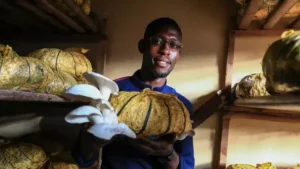
Despite the relative abundance of fungal life, formal cultivation practices remain limited. The result is a fungi-cultural system that’s seasonally bound and unpredictable, vulnerable to overharvesting, and economically inefficient. This need for stability in the market makes for exciting opportunities to develop industry and the infrastructure needed to sustain it. Problems with implementation, however, are manifold.
Barriers to Commercializing African Mushroom Species
There are a number of reasons why indigenous African mushrooms haven’t yet followed the path of the oyster or the shiitake. The first is research bias. Most global mushroom science focuses on species already popular in Europe, North America, and East Asia. Indigenous African species simply haven’t received the same funding or laboratory attention. Lack of global market demand naturally follows from this de-emphasis on research and underrepresentation in cuisine. But one need only look to oyster mushrooms in the United States for an example of how quickly a mushroom can go from “experimental” to “everywhere”.
Second, many species have complex life cycles. Termite-associated mushrooms in particular don’t fit neatly into standard grow-room models. Their symbiotic relationships make domestication more difficult, though not impossible. Both of these factors combine to form a knowledge gap. Traditional communities know which mushrooms are edible, medicinal, or dangerous, but that knowledge isn’t always documented in a way that modern agriculture can easily adopt. Finally, market systems tend to favor familiarity. Supermarkets know how to sell button mushrooms. Indigenous mushrooms often lack branding, standardization, and consumer education. None of these challenges are deal-breakers in and of themselves. They are merely indicators of an undeveloped sector.
Cultivating P. tuber-regium on African Agricultural Substrates
Despite the many challenges surrounding domestication, mushroom cultivation is still happening–just not at scale. Most of the indigenous African mushrooms of interest respond well to substrate-based cultivation, especially when agricultural waste is utilized as a nutritional base. Innovation abounds, with small-scale farmers using palm fronds, banana stems, rice straw, and corn cobs as growing media for their fungi. All of the usual hurdles are present–contamination, pests, and inconsistent performance. But, as all home growers can attest to, deceptively simple solutions can make these factors a non-issue.
Community projects in Nigeria and East Africa have already shown success using banana stems, palm residues, and urban organic waste as substrates. Women-led cooperatives in particular have adopted mushroom farming as a low-capital, high-return activity. For growers interested in regenerative agriculture, indigenous mushrooms fit perfectly into sustainable food systems. Still, there remains the issue of scalability. 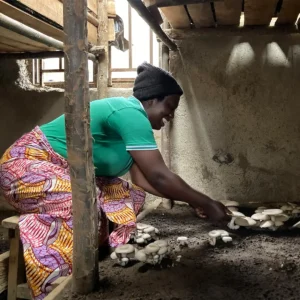
The review identifies a few key developments that would pave the way for large-scale mushroom cultivation across Africa: better strain selection through selective breeding; improved spawn quality and pasteurization techniques; optimized substrate blends; controlled environments where humidity and temperature can be regulated; and low-cost digital monitoring tools. As consumers become more nutrition-conscious and demand increases, we can expect to see these tools implemented at scale. Conservative estimates give it five years before the commercial mushroom industry becomes a powerhouse in African agriculture.
Mushrooms as a Remedy for Food Security and Nutritional Deficits
There is, of course, no such thing as the perfect food or the perfect crop, but mushrooms come pretty damn close. Their nutritional profile alone is an astounding testament to their potential to revolutionize the health and longevity prospects of the continent with the highest rates of extreme poverty in the world. Many species contain 30-40% protein by dry weight, and boast a rich and complex micronutrient profile that includes potassium, magnesium, selenium, and vitamins A through D. As if these bonafides weren’t enough, their antimicrobial properties are well-established.
In many parts of Nigeria and Kenya, diets rely heavily on staple crops like maize, cassava, or rice. While filling, these foods are often low in essential micronutrients. Indigenous mushrooms offer a powerful nutritional compliment to the standard diet. They require minimal land and aren’t a particularly resource-heavy crop. They can be added to soups, stews, sauces, or dried and powdered for fortification. Some initiatives are already exploring mushroom-enriched flours and snacks, especially for children and pregnant women. For food security advocates, indigenous mushrooms represent one of the most low-cost, high-impact nutritional interventions available.
In regions where people know how to cook them, mushrooms are highly valued. In parts of Nigeria, mushrooms like Termitomyces are prized additions to soups such as egusi or ofe nsala. In western Kenya, indigenous mushrooms are stir-fried with onions and tomatoes and served with ugali or rice. Where acceptance drops, the reasons are all-too familiar: fear of toxicity, cultural taboos, lack of exposure, and limited cooking knowledge. All of these factors, like the above-stated limitations on scalability, are eminently addressable.
From an environmental perspective, indigenous mushrooms tick all the right boxes. They grow on agricultural waste, require very little water and essentially zero pesticides, and they produce high protein per-square meter. In addition, they biodegrade waste, recycle nutrients back into the soil, and support circular agriculture.
Building Infrastructure for the African Mushroom Industry
As consumers worldwide look for nutritious and sustainable foods, indigenous mushrooms have the potential to move from forest floors to grow rooms, and from seasonal treats to year-round staples. Demand is plentiful and knowledge is readily available–the only thing missing is standardization of growing practices, reliable supply, and widespread awareness. This research makes one thing clear: indigenous mushrooms are not “too difficult” to cultivate. They’re simply underdeveloped, and the infrastructure has yet to catch up to the demand. For mushroom growers, researchers, and entrepreneurs, the opportunity lies in improving cultivation techniques, preserving and validating traditional knowledge, educating consumers, and establishing local and regional markets. The fungi themselves are already resilient, nutritious, and well-adapted to their environments. The difficult part isn’t growing the mushrooms themselves, but growing the systems around them.