
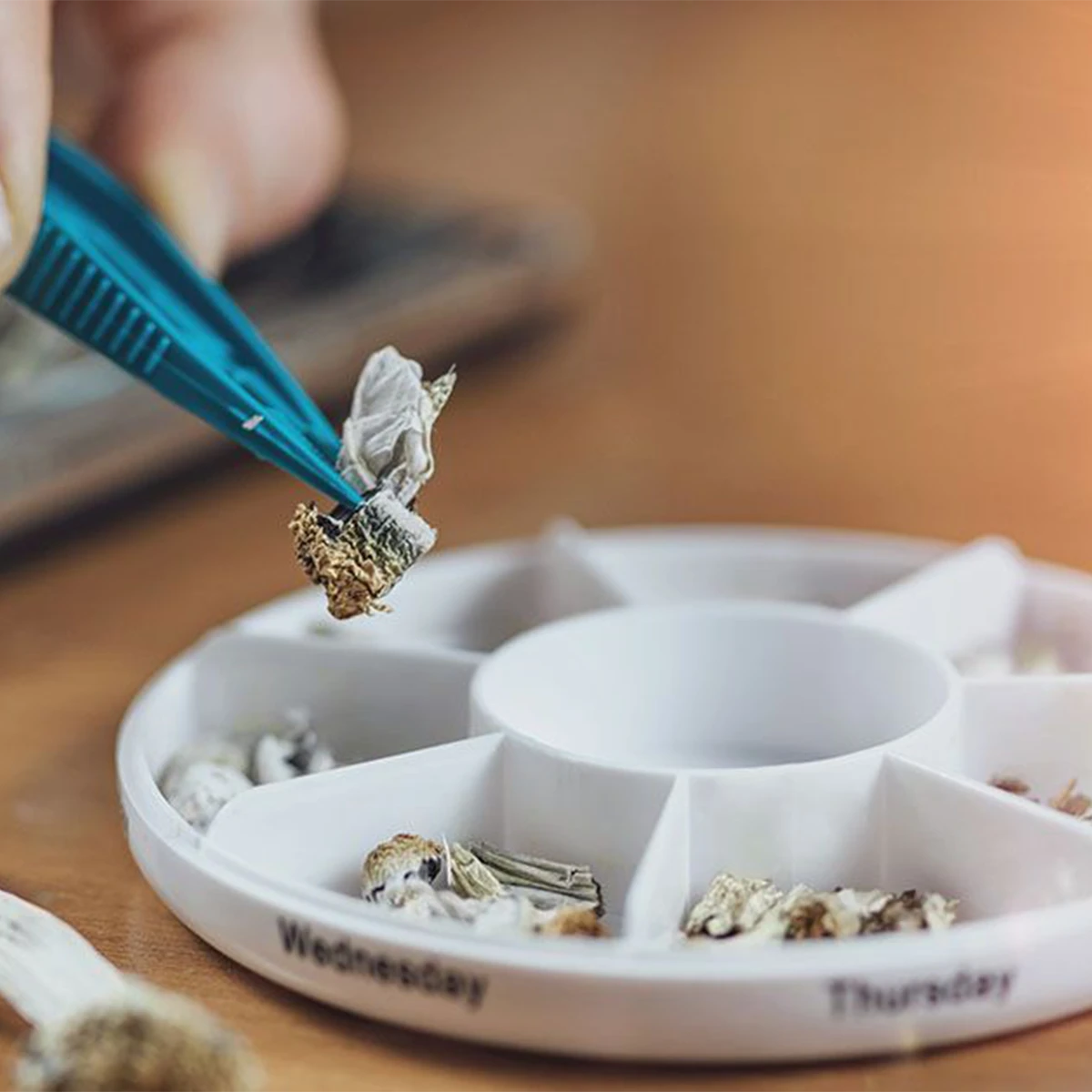
Public interest in microdosing psilocybin mushrooms, grown from magic mushroom spores, has increased considerably over the past few years, and scientific research has done its best to keep up. Countless articles, podcasts, and full-length books have come out extolling the virtues of this practice, which involves the semi-regular consumption of small, imperceptible doses of psilocybin mushrooms. The picture that the data paints, however, is much more complicated than the community conversation tends to reflect. Depending on which studies you read, microdosing either produces consistent, meaningful improvements in mood and cognition or performs no better than a sugar pill. Both of those things are kind of true, and understanding why requires taking a closer look at how the research has evolved. What follows is an effort to condense over a decade’s worth of good science into a comprehensive, digestible summary, and to paint a full picture of the current state of microdosing research.
Fadiman’s Foundation
Most of the modern conversation about microdosing protocols traces back to James Fadiman’s work. His 2011 book The Psychedelic Explorer’s Guide outlined a simple every-three-days dosing schedule and framed microdosing as a practice–something worthy of structure and attention. Over the following years, Fadiman collected thousands of self-reports from people following the protocol, documenting consistent themes across the accounts: improved focus, better emotional regulation, more creative thinking, reduced anxiety.
This wasn’t clinical research, and Fadiman never claimed it was. But the sheer volume of consistent self-reporting made it hard to ignore, and it gave researchers a meaningful starting hypothesis. The question the formal studies have been trying to answer ever since is whether or not those experiences hold up under the scrutiny of the scientific method.
The Observational Model and its Limits
The first generation of formal psychedelic research stayed close to Fadiman’s approach: follow people who are already microdosing, and see what happens. A 2022 naturalistic study in Scientific Reports tracked over 950 psilocybin microdosers for about a month alongside a non-microdosing comparison group. Microdosers showed small-to-medium improvements in mood and mental health, and the effect was fairly stable across age groups, genders, and whether or not participants had pre-existing mental health conditions.
One finding that stood out: participants who used a stacking protocol (combining psilocybin with lion’s mane mushroom and niacin, following a regimen that’s circulated widely in the magic mushroom community) showed additional effects beyond psilocybin alone. The researchers were cautious about drawing firm conclusions from that particular piece, but it’s a thread that keeps appearing in community reports and hasn’t been adequately studied yet.
The observational findings were consistent enough to be taken seriously. The problem is that observational studies can’t tell you whether psilocybin itself is responsible for the improvements, or whether something else like expectation, attention, the placebo effect, or the simple act of building a devotional, structured wellness routine, is doing most of the heavy lifting.
What The Trials Found
When researchers introduced double-blind placebo controls, where participants don’t know whether they’ve received active psilocybin or an inert substitute, the results became considerably harder to read in a positive direction. A 2021 preregistered double-blind study found that psilocybin microdosing produced no measurable improvements in emotional processing, anxiety, or depression relative to placebo. A 2022 double-blind study reached similar conclusions and specifically raised the possibility that expectation effects were driving the benefits people reported in open-label settings.
The most recent and methodologically rigorous work is a 2025 paper in Neuropharmacology that drew on data from two separate double-blind longitudinal trials. It found no reliable evidence that microdosing improved cognitive or emotional functioning beyond what the placebo group experienced. The authors didn’t close the door on microdosing research, however. Instead, they pointed toward individual differences and specific subpopulations as areas where real effects might still emerge. Nevertheless, the primary finding still directly contradicts the self-report literature.
This is the central tension the field is sitting with: the observational evidence and the controlled trial evidence are pointing in different directions, and as of yet nobody has fully reconciled them.
Creativity Is a Different Story
The one area where controlled research has found something worth noting is creativity, specifically in the domain of what scientists call “divergent thinking”. A 2025 mega-analysis combining data from three separate double-blind placebo-controlled trials looked specifically at creativity outcomes. Convergent thinking, thinking of the type that leads to a single correct answer, showed no improvement with active microdosing–while divergent thinking, thinking of the type that leads to a broader, more creative array of answers, showed a more interesting pattern: participants didn’t generate a higher volume of ideas, but the ideas they produced were rated as more original relative to the total. The ratio shifted even though the raw output didn’t.
The effect was modest, and it wasn’t consistent across all three trials in the analysis. But in the context of a well-controlled study design, finding any replicable signal around creative originality is meaningful. It suggests that if microdosing has a specific cognitive effect, it may be narrower and more targeted than the broad enhancement narrative implies, and that creativity research might be the most productive area for future investigation.
How Many People Are Actually Doing This?
A RAND Corporation survey published in early 2026, the first nationally representative, probability-based survey of psychedelic use in the US, put some numbers to what most people in this space already sensed was a widespread practice. An estimated 9.55 million American adults microdosed psilocybin, LSD, or MDMA in 2025. Psilocybin was the most commonly used psychedelic overall, with roughly 11 million Americans reporting past-year use. Among those past-year psilocybin users, 69% reported microdosing at least once. Nearly half of the 200 million-plus days of psilocybin use captured in the survey involved microdosing.
The lead researcher said she was “surprised” by the scale. The co-authors called the numbers “astounding.” The survey also confirmed what qualitative research and anecdotal reporting has long suggested: people microdosing are overwhelmingly doing so for mental health reasons, and a substantial portion of them are managing it without telling their doctors.
Why the Gap Exists
The disconnect between self-reported experience and placebo-controlled outcomes has a few plausible explanations, and they’re not mutually exclusive. Variability is a significant factor. Dose, schedule, mushroom potency, and individual neurochemistry all differ enormously across microdosers. A clinical trial that averages across all that variation may be washing out real effects that only exist in specific contexts or populations. The 2025 Neuropharmacology paper specifically flagged this as a reason to study individual differences more carefully going forward.
The placebo effect in mental health research is also large and noteworthy and a real phenomenon worth understanding. Expectation, attention, intention, and the experience of taking a meaningful action around mental health all have measurable psychological effects. Some portion of what microdosers report is almost certainly driven by those factors, though how much is an open question.
There’s also a mismatch between what the trials measure and what the microdosers describe. Controlled trials typically run for weeks and measure discrete outcomes. The changes people attribute to microdosing tend to be slower and more diffuse: a gradual reduction in baseline anxiety, a shift in emotional reactivity, a sense of slightly better access to creative states over time. These are difficult factors to operationalize and capture in short-window clinical designs.
Safety
Psilocybin is physiologically non-toxic and produces no physical dependence. European drug harm assessments have consistently rated it as substantially less harmful than alcohol or tobacco. No lethal dose in humans has been established.
For microdosing specifically, the adverse effects documented in trials are mild: headaches, occasional nausea, and temporary anxiety spikes, most commonly in people who already have elevated anxiety. There are open theoretical questions about cardiac effects from long-term repeated serotonin receptor activation, but no clinical evidence of harm has emerged from the existing research. Longer-term safety studies are still needed and are a reasonable ask given how many people are using this regularly.
Where the Research Stands
Psilocybin microdosing is one of the more actively researched areas in psychedelic therapy right now, which is a recent development. Oregon and Colorado have moved toward regulated therapeutic access. New Jersey has committed state funding to psilocybin research. The institutional infrastructure now exists to run larger, longer, better-designed trials than anything published so far.
The observational evidence is broadly consistent with what Fadiman’s early self-report collection suggested, while the controlled trial evidence is more sobering. What the field needs, and is now positioned to pursue, are studies designed to identify who responds, under what conditions, and through what mechanism. Averaging across everyone and calling it inconclusive isn’t the end of the story, but (hopefully) the beginning of a more useful set of questions and more cleverly designed studies. The jury on microdosing is, for now, still out.