
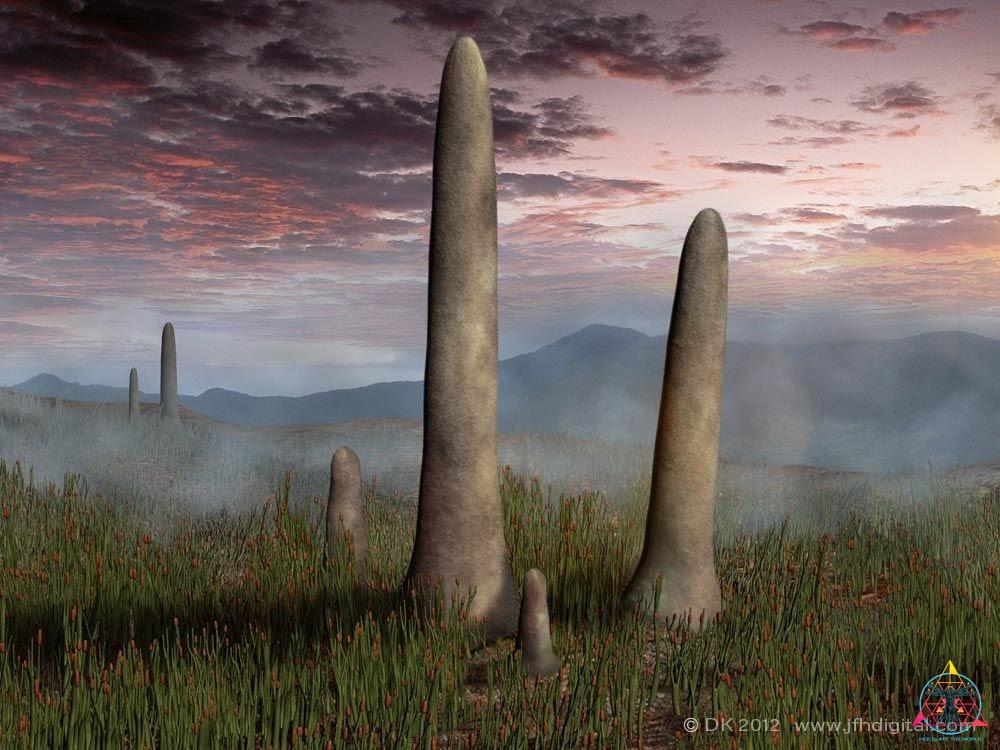
The common thought is that a billion years ago, in the Proterozoic era, the Earth’s land looked very different, no trees, no vascular plants, no animals. It was basically a bare rock with cool stuff in the water. Except it wasn’t. A research scientist in Canada has recently discovered a fossil of what she named Prototaxites (artist interpretation above). The fossil fragments are believed to be part of the 10-meter (33 feet) tall monolith of a fruiting body, potentially dispersing spores, and covered in holes presumably made by small organisms like insects and arthropods.
If we stop and look around in this era, all we will see is minerals; rocks; and mushrooms; never plants like we know. Vascular plants could not exist in this time yet, there was no soil, no soluble nutrient, no water holding qualities of any substrate around. Based on this finding, it took 500 million years for mushrooms to form the surface of earth into what could even be considered habitable for any vascular plant. Vascular plants made their way onto the scene in the Ordivician period (460MYA) with the internal incorporation of fungus. This relationship is described as endomycorrhizal symbiants, the mycelium is literally inside the plant in between plant cells. The symbiants trade the plant’s carbon for the mushroom’s soluble phosphorus, silica, nitrogen, water, and other micronutrients.
This new tag team quickly colonized vast swathes of shores very quickly and started to diversify just as fast. Soon enough there were forests of these symbiants, forming huge colonies that would have been bigger than any forest you could ever imagine. Mycorrhiza fungus species quickly adapted so it could assist multiple plant species, soon these forests had thousands of species of both plants and mushrooms. These huge forests had millions of miles of strands of mycorrhiza spanning mere square miles, this network could relay information back and forth for miles transporting nutrients, warning of pests, water distribution, antimicrobials, and the list goes on.
Deforestation has been a huge loss to not just the tree population but to unknown and non studied species of mycorrhizae that we will never get the chance to ever study again. This is the preface to a soil amendment post so you know why it is important for all plants, not just what you wanna grow. There are a few species of plants now that can exist without a fungal symbiont, every single one of them has tested to perform better growth and overall health wise when mycorrhiza is present.