Golden Teacher Mushrooms: The Complete Strain Guide
An Introduction to Golden Teacher
Golden Teacher is one of the most widely recognized and studied strains of Psilocybe cubensis. It was first documented in the mid-1980’s, and named for its distinctive, golden-capped fruits. Since its initial discovery, Golden Teacher spread in the mycology community quickly, and has remained one of the most popular strains on the market.
For microscopy researchers and spore enthusiasts, Golden Teacher is considered an ideal starting point. The strain produces consistent, dense spore prints, and its spore syringes are easy to work with. Its morphology is distinctive enough to make mushroom spore identification straightforward under a microscope. It remains one of the best-selling cubensis strains worldwide. It’s favored by mycology experts, but comes highly recommended for beginners too.
This guide covers everything you need to know about the Golden Teacher strain, from its origins, spore morphology, and physical characteristics, to its unique variants, and where to find verified Golden Teacher spores for microscopy research
.
Golden Teacher Strain Facts
Strain
Golden Teacher (GT
Species
Psilocybe cubensis
Origin
Unknown: first documented in the 1980's
Spore Print
Dark purple-brown to black
Cap Color
Golden to caramel-yellow
Cap Size
40-80 mm diameter
Stem
Thick, white to off-white
Origins & History
The precise origin of the Golden Teacher strain is not fully understood, and is mostly documented by internet lore rather than conclusive historical sources on mushroom spores. The strain is widely believed to have first appeared in the United States during the mid-to-late 1980s, with Florida frequently cited as the likely geographic source. Because P. cubensis grows naturally in Florida’s warm, humid subtropical conditions, these limited accounts are consistent with our understanding of the species.
Lore abounds regarding the origins of Golden Teacher’s name. While the strain has certainly earned a reputation for its ability to provide a valuable learning experience for mycology hobbyists, the most concrete connection to its name comes from its physical characteristics, such as its beautiful golden cap.
What distinguishes Golden Teacher from the many cubensis strains that emerged during the same era is that it was quickly stabilized and isolated by the community. While strains like Tosohatchee and Costa Rican Cubensis were sought after based on their specific geographic origins, Golden Teacher was quickly stabilised and popularised by early growers who valued its combination of consistent yields and reliable spore production.
Once the original Golden Teacher was stabilized, mycologists began working on their own unique isolations of those original genetics. The Golden Teacher lineage, which was important in its own right, became the origin point for major innovations in the mycology community.
By the 1990s and early 2000s, Golden Teacher had established itself as the most widely distributed cubensis strain in the microscopy hobby worldwide. It remains, by sales volume and name recognition, the benchmark against which other cubensis strains are measured.
Classification
Golden Teacher is one strain in the species, Psilocybe cubensis, which is the most widely studied and cultivated magic mushroom species worldwide. Because Psilocybe cubensis is a species classification, all cubensis mushrooms have the same higher order classifications, like Genus, Family, Order, Class, and Division. What sets different strains of cubensis apart is a miniscule fraction of their genetics. This tiny fraction is mostly responsible for minor variations in phenotype (meaning observable traits) like color and size. Although these differences seem major because they’re the main ones we can see, these are actually extremely minor differences genetically speaking, and the vast majority of genetic material stays the same across all strains of Psilocybe cubensis species. .
Kingdom
Fungi
Division
Basidiomycota
Class
Agaricomycetes
Order
Hymenogastraceae
Family
Psilocybe
Genus
Psilocybe
Species
Psilocybe cubensis
Strain
Golden Teacher (informal cultivar name)
Physical Characteristics of Golden Teacher
Cap (Pileus)
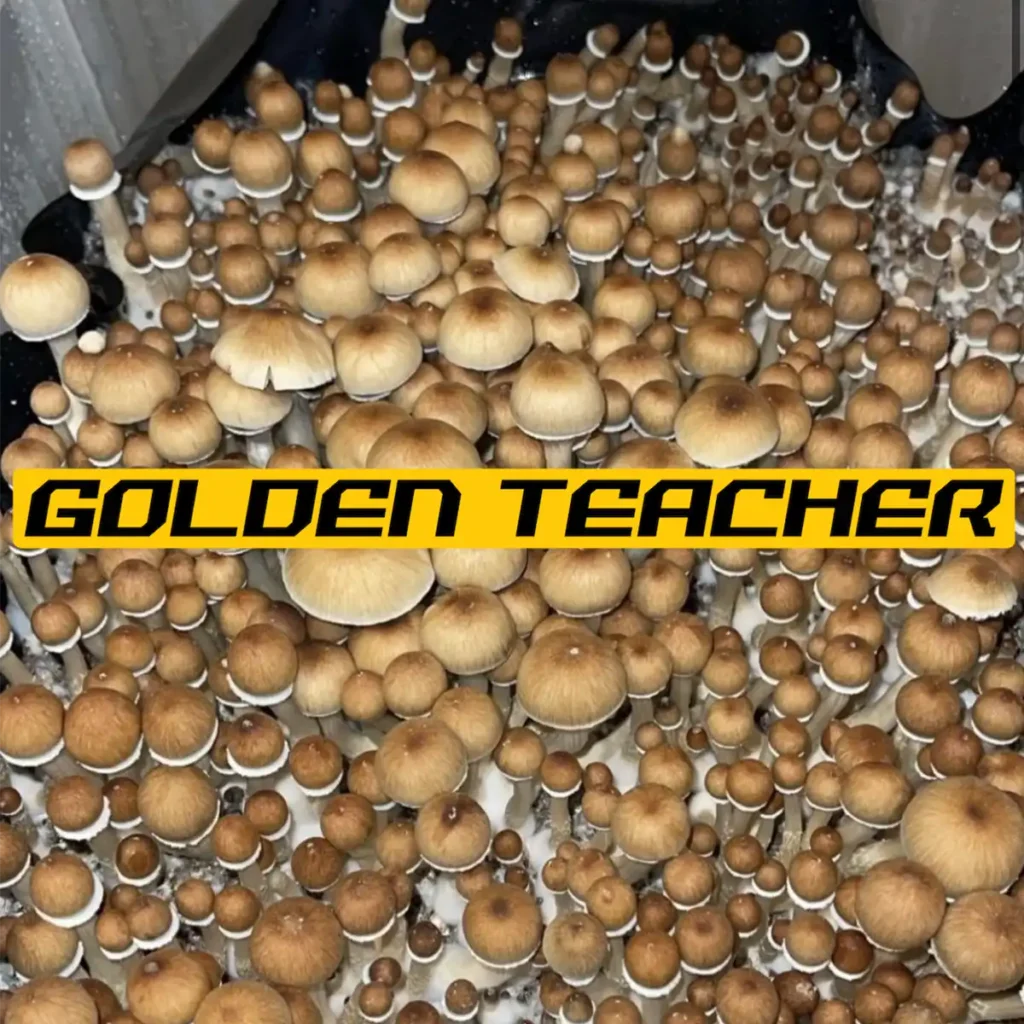
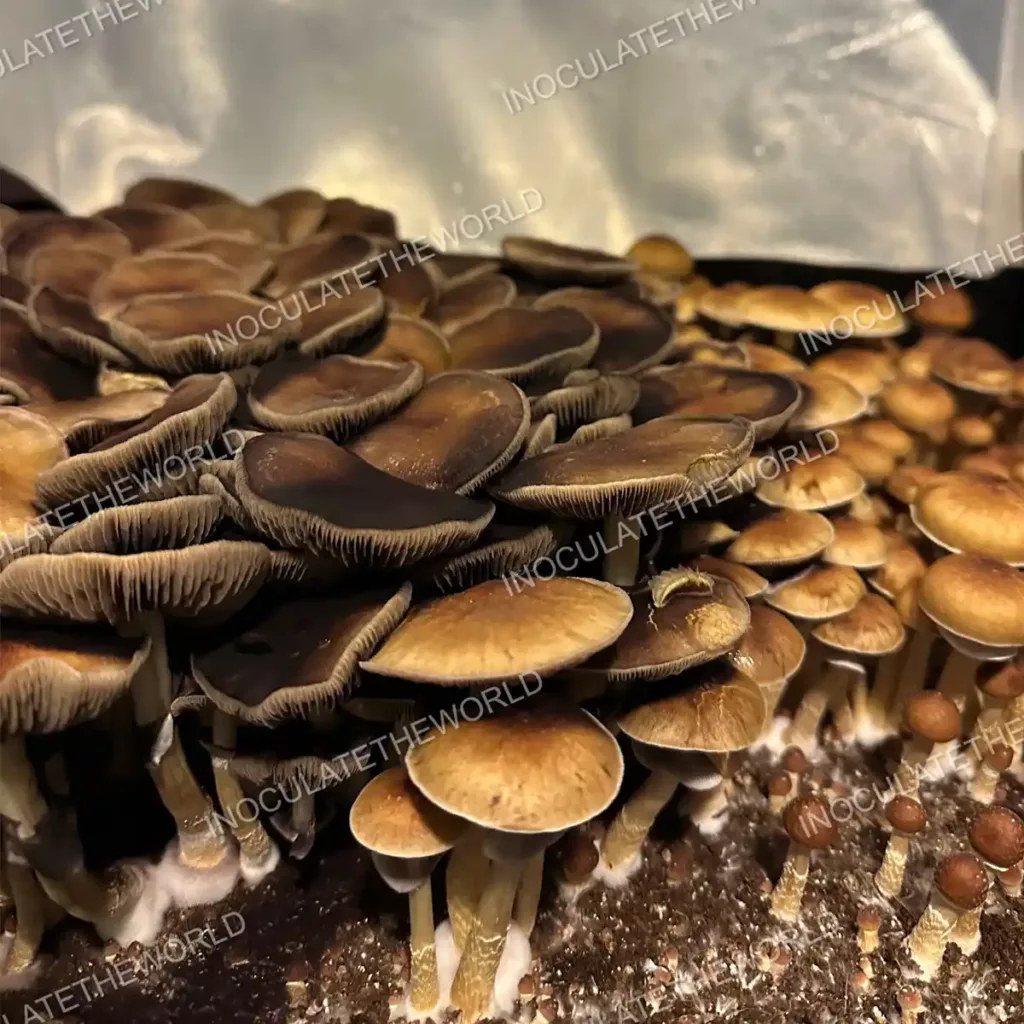
Golden teacher’s caps change throughout different stages of fruiting. When fruits are young, the caps are typically broad and convex, but as the mushroom matures, the caps flatten and even develop a slight depression in the middle. The caps range in diameter from 40-80 mm, but can grow even larger depending on environmental conditions. The color can range from a vivid golden yellow, to pale caramel or cream colored, with more pigmentation at the center of each cap. The caps are smooth, with relatively uniform and saturated coloration compared to other cubensis varieties which often show more speckled or olive-toned traits.
Stem (Stipe)
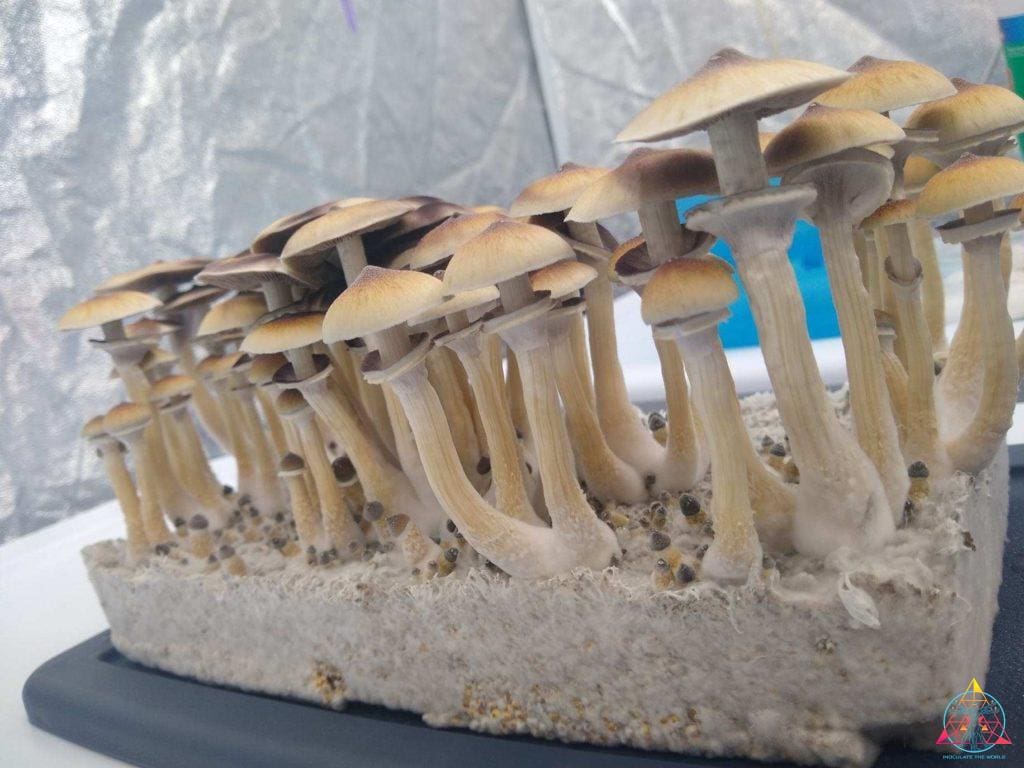
Golden Teacher’s stems are relatively robust, reaching between 10 and 20 mm in diameter, thickening towards the base of the mushroom. Their length can vary greatly; it’s typical to see stems anywhere from 40 to 150 mm. Stems are typically white to off-white, so the majority of the strain’s pigmentation can be seen in its caps rather than its stems. Like all magic mushrooms, the flesh bruises to a blue-green color when handled, due to the oxidation of psilocin. This blue-green color is a reliable signal of psilocybin related alkaloids in species like Psilocybe cubensis.
Gills & Veil
This strain features close-set gills, which are pale grey while the fruit is young, but gradually darken to deep purple or black as spores mature and drop. The gill shape can be adnate to adnexed, meaning they can be broadly attached to the stem, or that they narrow before reaching the stem. Golden Teacher also has a partial veil which covers the gills before full maturity. As the mushroom grows, the veil breaks, and remains on the stem, forming a “skirt-like” structure called an annulus.
Spore Print
Golden Teacher produces dark purple and brown spores in heavy, dense deposits that are easy to collect as spore prints. The strain’s reliable spore production makes it one of the best strains for making spore prints.
Golden Teacher’s Spore Profile
Under the microscope, Psilocybe cubensis spores, including Golden Teacher spores, are ellipsoid to subellipsoid in shape, meaning they are oval-shaped, but vary a bit in terms of their length to width ratio. They typically measure around 11.5–17 × 8–11 micrometres. Psilocybe cubensis spores have thick, smooth walls, and when clustered together, spore deposits will look dark purple or brown. Their basidia usually produce four spores each, with each spore bearing half of the genetic material needed to create a new mushroom.
Golden Teacher offers an incredible consistency in its spore production, which makes it well-suited to microscopy research. Its prints and syringes show high spore density, which helps with factors like contamination risk, as well as the general straightforwardness of the research. They also store well, and can be maintained as long-term reference samples.
Golden Teacher spores are available from Inoculate the World in several formats depending on your research needs:
Spore Print — suitable for long-term archival and print-to-syringe preparation
Spore Syringe — ready-to-use suspension for immediate microscopy work
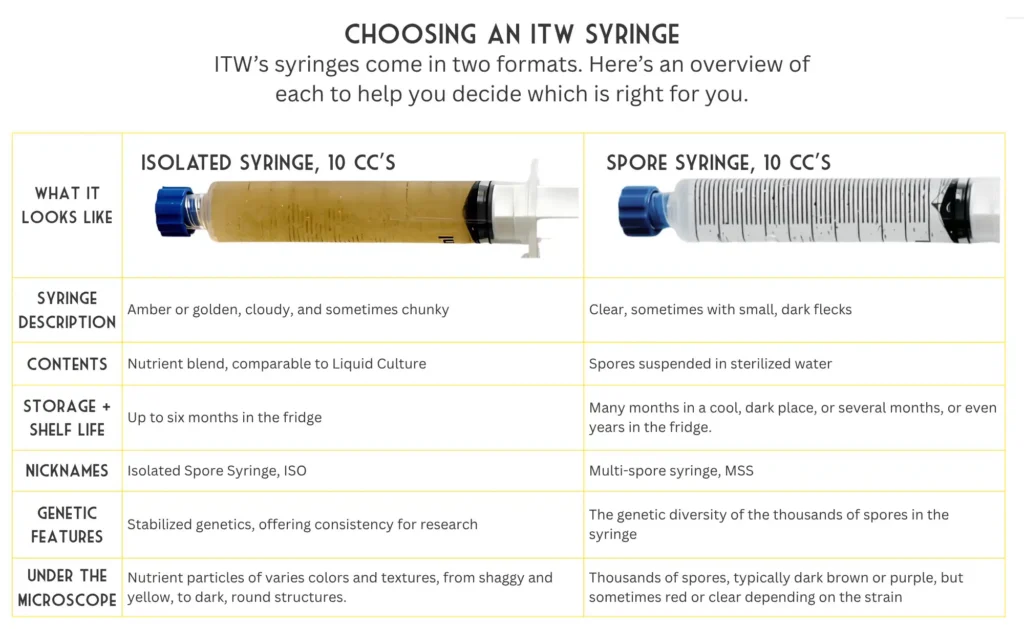
Isolated Spore Syringe — single-strain isolated genetics for precision research
Potency & Effects
No magic mushroom spores contain psilocybin. Psilocybin is produced when a spore grows into a mushroom. In terms of potency, Inoculate The World’s Golden Teacher spores themselves contain no psilocybin, or other active compounds that mushroom fruiting bodies contain. The main source in most mushroom genetics products is the mushroom spore, which is well known not to contain any active compounds. This is why mushroom spores are legal for microscopy and research purposes in the United States. These compounds, such as psilocybin, are only found in the later stages of some species’ life cycles, such as a Psilocybe cubensis mushroom’s fruiting stage.
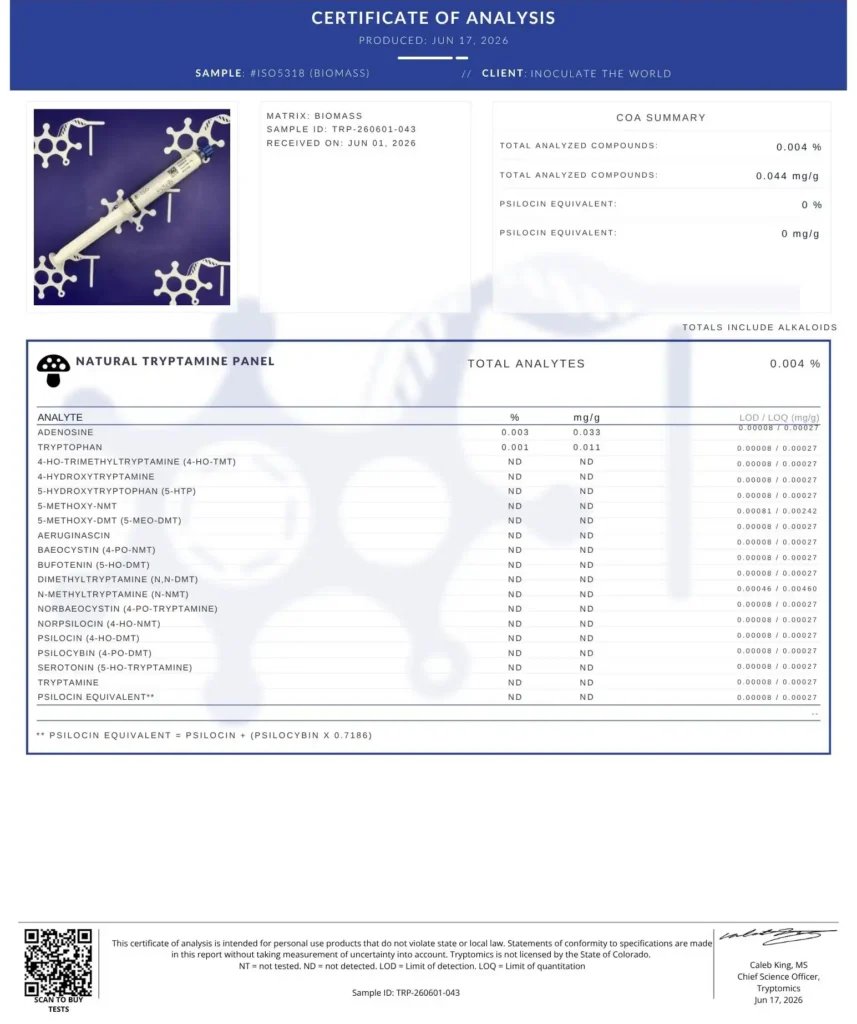
Many genetics companies encounter gray areas with liquid cultures containing active compounds, but you can rest assured that all of our products, including isolated syringes (comparable to liquid cultures), have none of these active compounds inside the syringe. Our spore syringes are produced with special ingredients to prevent these compounds from forming inside the liquid itself, and we thoroughly test our products to verify this. Our recent certificate of analysis from Tryptomics confirms it.
This is the standard we hold all of our products to. Across the board, all of our isolated syringes test at zero for psilocybin, psilocin, and other psychoactive compounds found in the fruiting bodies of mushrooms.
Many genetics companies encounter gray areas with liquid cultures containing active compounds, but you can rest assured that all of our products, including isolated syringes (comparable to liquid cultures), have none of these active compounds inside the syringe. Our spore syringes are produced with special ingredients to prevent these compounds from forming inside the liquid itself, and we thoroughly test our products to verify this. Our recent certificate of analysis from Tryptomics confirms it.
This is the standard we hold all of our products to. Across the board, all of our isolated syringes test at zero for psilocybin, psilocin, and other psychoactive compounds found in the fruiting bodies of mushrooms.
Beyond psilocybin and psilocin, other minor tryptamines found in the later growth stages of magic mushrooms are also absent from our isolated syringes. These include baeocystin, an analog of psilocybin, norbaeocystin, an alkaloid and precursor of psilocybin, norpsilocin, a metabolite of baeocystin, and 4-hydroxytryptamine, a metabolic starting compound in the mushroom’s biosynthesis pathway. Inoculate The World’s products test negative for all of these compounds and are guaranteed to contain no active compounds inside the syringes themselves.
Golden Teacher Variations
Leucistic Golden Teacher (LGT)
Leucistic Golden Teacher is a pigmentation variant characterized by reduced melanin production, creating pale, and even near-white fruiting bodies. Leucism is a genetic trait that results in reduced pigmentation (rather than albinism, which is a complete lack of pigmentation), meaning the spore print still has its characteristic dark purple-brown colour despite the pale cap and stem. LGT is prized in microscopy research for its visual distinctiveness as a leucistic strain.
White Golden Teacher
White Golden Teacher is another variant that was stabilized for its unique phenotype. This strain exhibits almost a complete loss of cap pigmentation, which produces a visually striking white or cream-colored fruiting body. It shares the same spore morphology as your typical Golden Teacher specimen, but is genetically distinct from the original Golden Teacher and its variants.
Available: White Golden Teacher Spore Syringe · White Golden Teacher Isolated Syringe · White Golden Teacher Spore Print
True Albino Teacher
True Albino Teacher is another isolation of Golden Teacher, which itself has several different isolations. In general, True Albino Teacher exhibits no pigmentation, hence its name, “true albino” Its white fruiting bodies and clear spores make it albino, but it is descended from a rare albino mutation in Golden Teacher.
True Leucistic Teacher
True Leucistic Teacher is a further selected isolation of TAT, and is thus a great grandchild of the original Golden Teacher. This strain is leucistic, so it produces colorless caps and stems, but dark purple spores. Its caps are consistently large and often have wavy edges.
More on Golden Teacher
Readers can explore more on Golden Teacher with Inoculate The World’s educational resources. A general history of mushroom spores compliments a deeper investigation on Golden Teacher’s origins and history. You can also explore why Golden Teacher became so popular with our brief guide to the Golden Teacher mushroom’s history.
Beyond studying the spores themselves, Golden Teacher enthusiasts may be interested in merchandise like our Golden Teacher sticker to show off their interest on their laptop, water bottle, or any other place of their choosing.
Frequently Asked Questions: Golden Teacher
What is the Golden Teacher mushroom strain?
Golden Teacher is a strain (sometimes called a variety or cultivar) of Psilocybe cubensis, the most widely cultivated and studied psilocybin mushroom species. The strain is named for its gold-capped fruiting bodies, and it has become well- known as one of the most accessible and consistent cubensis strains available. Researchers appreciate its pleasant phenotype, from its gold-colored caps to its large size, as well as its reliable spore production, which makes it useful for all levels of microscopy research.
What does Golden Teacher look like?
Golden Teacher produces fairly typical looking Psilocybe cubensis mushrooms. The strain produces broad, convex (rounded) caps ranging from 40–80mm in diameter, with a distinctive gold or caramel color that is more uniform and saturated than most other cubensis strains. The stem is thick and paler than the cap (typically white or off-white), and the flesh bruises blue-green when handled. The spore print is dark purple or brown, and often looks black depending on how you look at it.
What are the Golden Teacher variants?
The two most well-known Golden Teacher variants are Leucistic Golden Teacher (LGT) and White Golden Teacher. LGT is leucistic, meaning it has reduced pigmentation, and produces pale fruiting bodies while still creating a standard dark spore print. White Golden Teacher is a further-selected strain with an almost complete loss of pigmentation on its cap. Both are available from Inoculate the World.
Are Golden Teacher spores legal?
Because spores do not contain psilocybin, magic mushroom spores are legal to purchase in most U.S. states. Researchers can legally buy and own these spores for microscopy and research purposes, because the spores themselves do not contain active compounds. Spores are illegal in a few US states, like Georgia, and Idaho, and cultivation is illegal in most U.S. states. Always verify your local laws before purchasing.
What is the difference between a spore syringe and an isolated spore syringe?
A spore syringe contains spores suspended in sterilized water. Even if all the spores in a syringe come from a single mushroom spore print, that syringe still has the potential for genetic variability. Each spore produced by a single mushroom is genetically unique, and contains half the genetic material needed to make a new mushroom. This means that formats like spore syringes contain the genetic variability of the thousands of spores and their thousands of potential combinations.
Conversely, an isolated syringe ensures genetic consistency across the whole sample. Isolated syringes are comparable to liquid cultures, meaning that the entire syringe contains one highly stabilized form of these genetics, ensuring a high level of consistency across the sample. Isolated syringes are preferred by people seeking the highest level of consistency in their microscopic work.