Psilocybin mushrooms, grown from magic mushroom spores, have seen remarkable legal victories over the last decade, and every state-level psychedelic reform so far has followed a similar script. Advocates spend years building a coalition, a national psychedelic-reform PAC pours money into signature gathering, and voters decide the question directly at the ballot box. That’s how Oregon legalized psilocybin magic mushroom services in 2020 and how Colorado did the same, plus a personal-use allowance, in 2022.
New Mexico has broken that pattern entirely.
In April 2025, Governor Michelle Lujan Grisham signed the Medical Psilocybin Act into law after it passed the state Senate 33 to 4 and the House 56 to 8, making New Mexico the third state to legalize supervised psilocybin access and the first to get there through its own legislature rather than a statewide vote. That distinction matters a great deal. Oregon and Colorado’s programs exist because well-funded national campaigns built the case directly to voters, spending millions on the kind of signature-gathering and advertising operation that only an organized industry can sustain. New Mexico’s law exists because a Republican state senator and a Democratic state senator agreed on something first, and then convinced their colleagues.
Legal Magic Mushrooms in New Mexico: How We Got Here
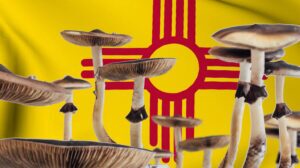
New Mexico’s approach stands apart from the broader patchwork of magic mushroom laws across the United States. The groundwork was laid a year before anyone wrote a binding bill. In February 2024, Senate Minority Whip Craig Brandt, a Republican from Rio Rancho, and Sen. Jeff Steinborn, a Democrat from Las Cruces, co-sponsored a non-binding memorandum asking the Department of Health to study whether a psilocybin mushroom therapy program made sense for New Mexico. It passed the Senate 37 to 0. Brandt, a veteran himself, framed the issue around fellow veterans dealing with PTSD and traumatic brain injury. Governor Lujan Grisham’s office endorsed the memorandum “in concept” the following week. Getting to that unanimous vote required nothing more than two legislators from opposite parties deciding the question was worth a serious look, and colleagues willing to find out alongside them, rather than any ballot campaign or outside PAC.
A year later, Brandt and Steinborn returned with Senate Bill 219, the actual Medical Psilocybin Act, and it moved through the legislature with the same bipartisan ease. It creates a strictly medical program: patients need a qualifying condition, currently defined as treatment-resistant depression, PTSD, substance use disorder, or end-of-life anxiety, along with a licensed physician’s recommendation, before they can access supervised psilocybin treatment. There’s no personal-use or home-grow allowance of the kind Colorado’s voters approved. Treatment follows a three-session structure, a preparation session, a supervised administration session, and a follow-up integration session, modeled loosely on Colorado’s facilitator system. All psilocybin used in the program has to be cultivated and produced inside New Mexico, a requirement state officials have said is meant to keep the program clear of federal trafficking exposure that would come with crossing state lines.
The law also does something Oregon and Colorado’s ballot measures didn’t: it builds equity into the statute itself. SB 219 establishes a Medical Psilocybin Treatment Fund specifically to help low-income patients afford the program, alongside a separate Medical Psilocybin Research Fund to support university and provider-led studies. The state appropriated an initial $2 million to the Department of Health for fiscal years 2026 and 2027, with roughly $1 million of that going toward new staff to build out the program.
Indigenous Perspectives on Psilocybin in New Mexico
New Mexico is home to twenty-four sovereign tribal nations, and the law accounts for that directly. It requires the Department of Health to conduct formal tribal consultation under the state’s existing State-Tribal Collaboration Act as it writes the program’s rules, and it mandates that the nine-member Medical Psilocybin Advisory Board include at least one enrolled member of a New Mexico tribe, pueblo, or nation, alongside a mental or behavioral health equity advocate and a military veteran.
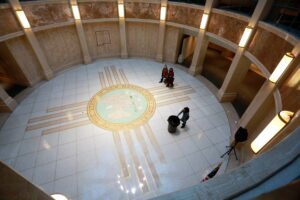
During the Senate floor debate, Sen. Angel Charley, a Democrat representing District 30 and a citizen of the Pueblo of Laguna, argued that the state was catching up to something Indigenous communities in the Southwest already understood. “This medicine is not groundbreaking,” she said. “It is only new to Western modalities of healing.” It’s worth being precise about what that claim covers: the ceremonial use of psychoactive plants with deep documented histories in the region, most prominently peyote among the Native American Church, is a different tradition from psilocybin mushroom use specifically, which has a much thinner documented history among Southwestern tribes compared to Mesoamerican traditions further south. Charley’s broader point, that altered states of consciousness have long been treated as legitimate tools for healing in Indigenous practice regardless of which specific plant or fungus carries that role, stands on its own regardless of that distinction.
What the consultation requirement does not do is create any separate legal pathway for religious or ceremonial psilocybin use outside the medical program. A tribal government whose members want to incorporate psilocybin into existing healing practices still has to work through the same qualifying-condition, licensed-physician structure as everyone else. The seat on the advisory board guarantees a voice in how the state’s medical program gets built. It doesn’t extend New Mexico’s peyote-style religious exemption to psilocybin.
Who Legalized Psilocybin in New Mexico?
Crystal Romero’s story shows up in most of the local coverage of the law’s passage, and it’s worth understanding why she became one of its public faces. Romero served in the New Mexico Army National Guard and came home with PTSD and depression severe enough that conventional treatment wasn’t resolving it. She encountered psilocybin therapy in Jamaica, where it’s legal, and has since become a vocal advocate for the New Mexico program, testifying about her experience as lawmakers debated the bill. Her account, and Brandt’s own framing of the law around veterans specifically, gave the legislation a constituency that had nothing to do with the psychedelic industry’s usual advocacy channels: a Guard veteran and a Republican state senator making a case to their own legislature, rather than a biotech company’s patient testimonial.
Parallel to the legislative track, the University of New Mexico’s Health Sciences Center has its own psilocybin-adjacent research underway, including a study of RE104, a short-acting psilocybin-related compound, for postpartum depression. That gives New Mexico something Oregon and Colorado didn’t have at the same stage: an in-state academic research program running alongside the regulatory buildout, rather than importing all its clinical evidence from elsewhere.
Is Psilocybin Legal in New Mexico?
The statute gives the Department of Health until December 31, 2027 to have the program fully operational. As of late 2025, the department told reporters it’s targeting a full year ahead of that, aiming to enroll its first patients by the end of 2026, citing higher than expected public interest. The Medical Psilocybin Advisory Board held its first meeting in December 2025, and as of this year, the department is still drafting rules covering training standards, approved treatment settings, and producer licensing, with no patient application process open yet. Whether the accelerated timeline holds is an open question. Department timelines on brand-new regulatory programs slip more often than they hold, and New Mexico is attempting something more granular than Oregon’s original service-center model, since every patient here needs a qualifying diagnosis and a physician’s involvement rather than simply an interest in the experience.
New Mexico also isn’t acting in isolation. Similar bills have moved through statehouses in Illinois, Arizona, Alaska, and Hawaii over the same stretch, suggesting a real second wave of state-level psychedelic policy distinct from the ballot-measure era of Oregon and Colorado. What sets New Mexico apart within that wave is how little of its momentum traces back to outside money. There’s no equivalent here of a Compass Pathways funding the political groundwork, no Antonio Gracias-style foundation gift shaping the conversation, no hedge fund backing a company positioned to benefit from the law’s passage. It’s no coincidence that the law’s most visible advocates are a veteran-turned-patient and two legislators from opposite parties who found more common ground on this than most other issues in Santa Fe.
The Future of Legal Psilocybin in New Mexico
None of this means New Mexico’s program is guaranteed to work as intended. A tightly gatekept medical model, three mandatory sessions, physician sign-off, state-licensed in-state cultivation, could end up as expensive and hard to access as Oregon’s has proven for many patients, equity fund or not. The tribal consultation requirement is a real procedural commitment, but it stops well short of the kind of religious-use protection that peyote has under federal and state law, and it’s fair to ask why psilocybin didn’t get the same treatment given the argument Charley made on the Senate floor. And an accelerated internal timeline from a state health department is a goal, not a guarantee.
What New Mexico does demonstrate is that a state can get to the same regulatory destination as Oregon and Colorado without the industry infrastructure, the PAC money, or the Nasdaq-adjacent financiers that have shaped the psychedelic story everywhere else this year. It got there because a Guard veteran told her own senator what had actually helped her, and because two lawmakers who agreed on almost nothing else decided that was worth a unanimous vote.