
If you follow the world of magic mushroom microscopy, you’ve almost certainly encountered the spores of Natal Super Strength or Transkei. They’re among the most popular specimens in the hobby, studied by enthusiasts and researchers alike. Like pretty much everyone else in the community, you’ve probably assumed that they were psilocybe cubensis mushroom spores. As it turns out, they belong somewhere else entirely. A paper published in March 2026 in Proceedings of the Royal Society B formally described a brand new species, Psilocybe ochraceocentrata, and the remarkable thing about it is where it was found: hiding in plain sight within the scientific and enthusiast communities, mislabeled and passed around under the wrong name for years.
Psilocybe ochraceocentrata is a wild-growing African species, collected from grasslands across South Africa and Zimbabwe. Its name comes from the ochre-yellow coloring at the center of its cap, a subtle feature that, in hindsight, might have raised questions sooner had researchers known to look for it. But subtle is the operative word here: to the untrained naked eye, it looks strikingly similar to psilocybe cubensis. Same general habitat, same growth patterns, similar physical characteristics across the board. Without molecular analysis, there is very little to distinguish it as something separate.
The subtlety of these two species’ differences is precisely why Psilocybe ochraceocentrata slipped through undetected for so long. Researchers kept encountering specimens during fieldwork conducted between 2013 and 2022 that resembled cubensis superficially but didn’t hold up under closer examination. Only after microscopic and genetic data were compared against the actual type specimen of P. cubensis did the African material reveal itself as something distinct. Six collections in total were formally studied, gathered across South Africa and Zimbabwe, forming the foundation of the new species description.
Lead researcher Dr. Alexander Bradshaw of Clark University noted that this kind of confusion is far from unusual in mycology. Two mushrooms can appear nearly identical to the naked eye while being separated by millions of years of independent evolution. That is, as it turns out, precisely what happened here.
The Psilocybe Natalensis Problem
This is where the paper becomes directly relevant to microscopy enthusiasts. The strain most commonly known as Psilocybe natalensis, and sold widely as Natal Super Strength, is not actually P. natalensis in any meaningful genetic sense. When researchers examined the publicly deposited genetic sequences for that commercial strain, the overwhelming majority clustered with the newly described Psilocybe ochraceocentrata, not with the genuine type specimen of P. natalensis. 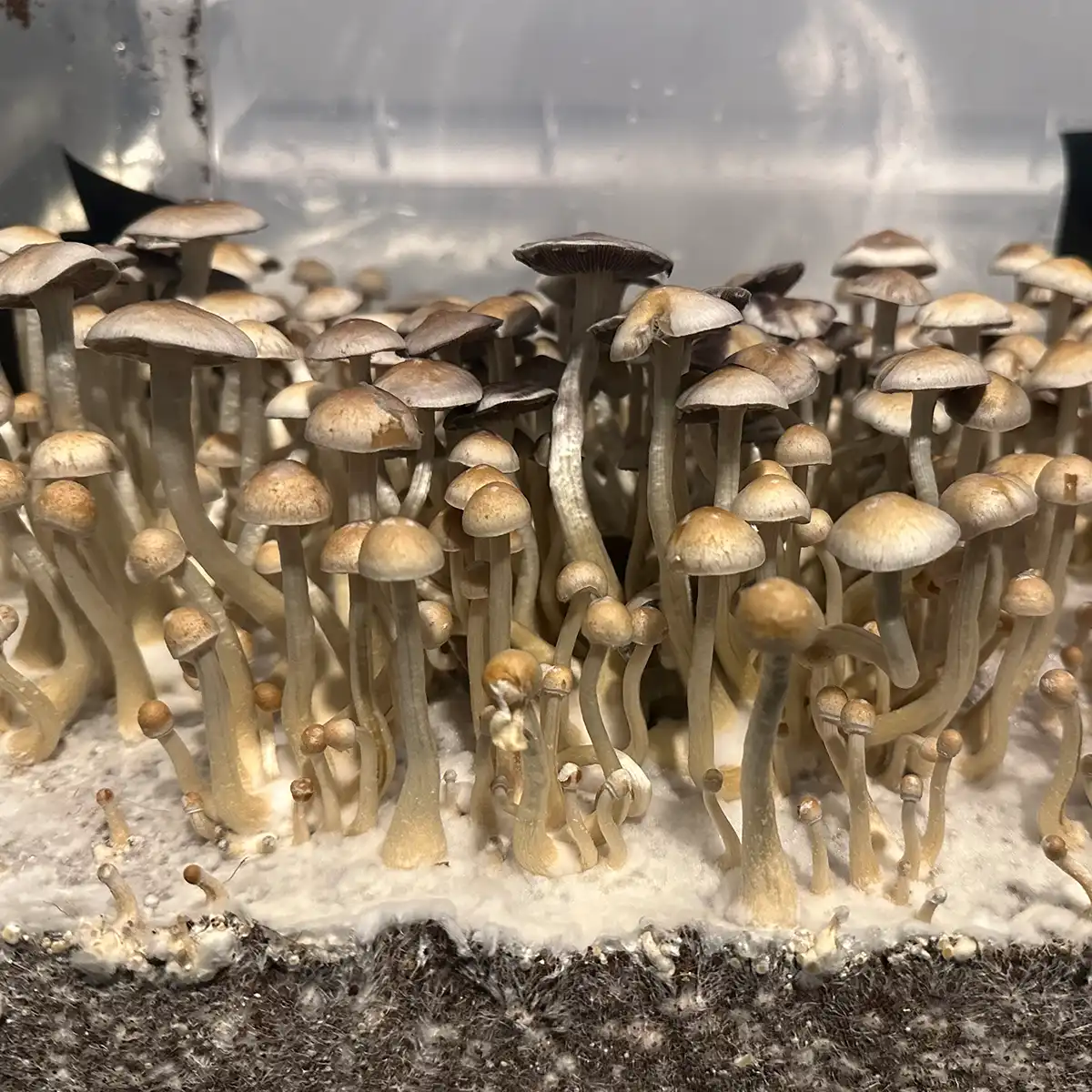
In plain terms: the organism the spore and mycology community has been calling “natalensis” is a different species entirely. A name got attached somewhere along the line, spread through vendors and online communities, and became standard, despite being taxonomically incorrect.
This is a well-documented problem in fungal taxonomy. Species names drift when nobody sequences the original physical reference collections. Databases accumulate incorrect identifications over time. Vendors pass along whatever name accompanied the culture they received. By the time anyone does the molecular work to untangle things, the wrong name has propagated across thousands of listings and catalogues, and revising the record is often dismissed as being more effort than it’s worth.
The broader implication here is that the name on a spore syringe may not reflect the underlying biology as accurately as assumed. That’s true of natalensis specifically, and likely true of other strains as well. Taxonomy is considerably messier than most labels suggest.
A Long Evolutionary Divorce
The genetic analysis in the paper estimates that P. ochraceocentrata and Psilocybe cubensis last shared a common ancestor approximately 1.5 million years ago. There is real uncertainty around that figure. The confidence interval runs from roughly 710,000 years to 2.55 million, and some researchers suspect the true number may be closer to half the central estimate.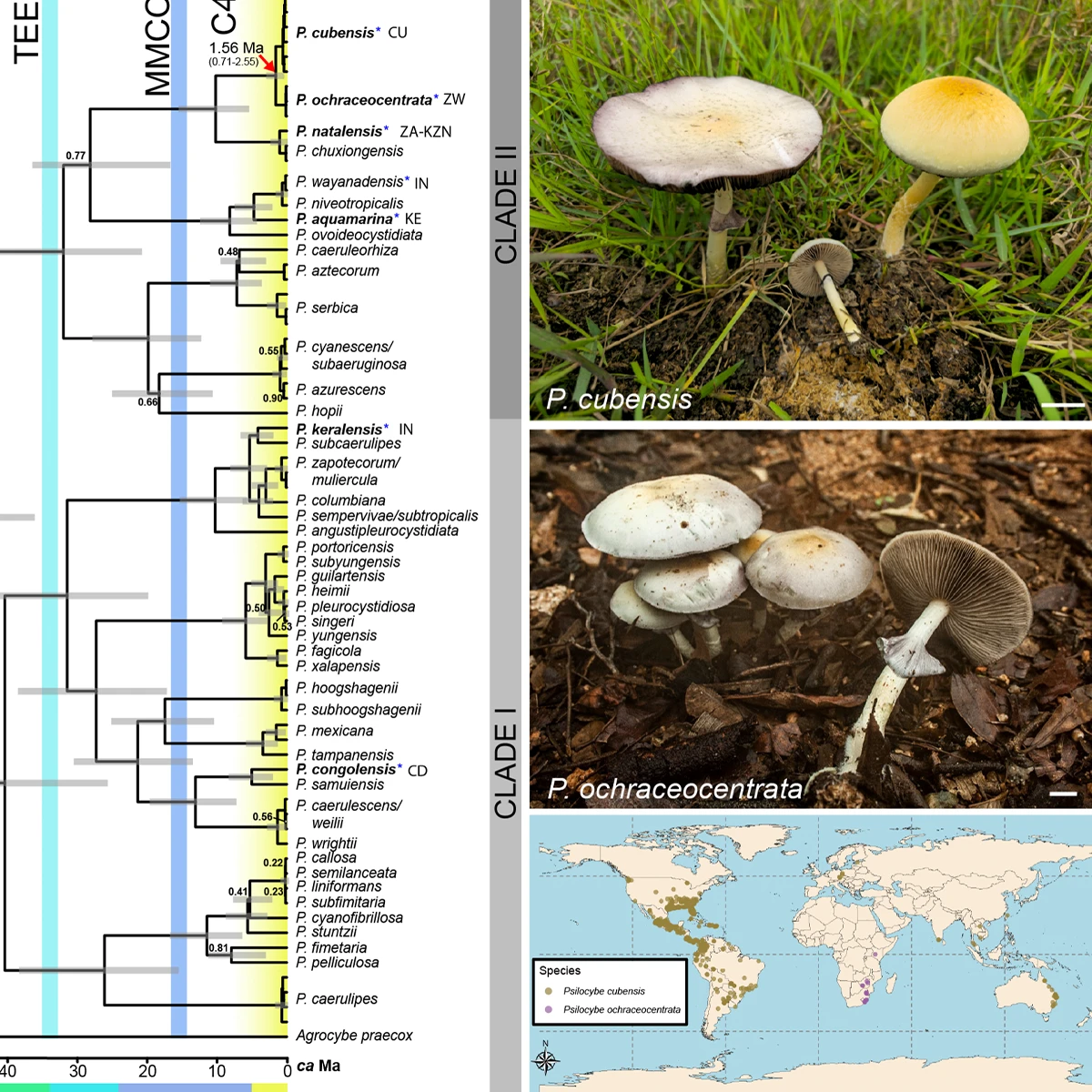
The methodology has acknowledged limitations, and the study’s authors are transparent about them. Even accounting for that uncertainty, the core finding still stands: these two species have been evolving independently for the whole genealogy of psilocybin. Far longer than any human trade route. Far longer than the domestication of cattle. Far longer than the existence of European colonial shipping lanes.
That last point reshapes a decades-old debate concerning the story of psilocybin-containing mushrooms’ arrival to the new world.
Troubling the Cattle Hypothesis
The dominant theory about P. cubensis origins, for the past four decades, has been that it is a relatively recent arrival in the Americas. Mycologist Gastón Guzmán proposed in 1983 that Spanish colonists accidentally introduced the fungus when they brought cattle to the New World in the 1500s. The reasoning was straightforward enough: cubensis mushrooms favor dung, cattle produce dung, and cattle were introduced from Africa and Europe. The implicit assumption was that Psilocybe cubensis was endemic to Africa before that point, hitching a ride across the Atlantic through its bovine hosts. It’s a logical story that has become increasingly difficult to defend.
If P. ochraceocentrata and P. cubensis diverged millions of years ago, then cubensis cannot have been sitting in Africa until the sixteenth century before being transported to the Americas. The timescales are simply incompatible. The paper argues instead that the split between these two species likely reflects a much older dispersal event, one that unfolded as grasslands expanded and grazing animals migrated across continents over geological time, not one that arrived aboard a colonial vessel.
Researchers are careful not to overstate this conclusion. P. cubensis has been documented growing from elephant and horse dung as well as cattle, which deeply complicates any single-host dispersal narrative. And more recent human-mediated movement, through Asian trade routes or Indian Ocean commerce, cannot be ruled out. Resolving the question properly would require large-scale genetic sampling across South America, the Caribbean, and Asia, difficult work that has not yet been done.
What the paper achieves is making the colonial cattle hypothesis look considerably less settled than it once did. The origin of Psilocybe cubensis is, once more, an open question.
A Continent Understudied
One of the subtler but more striking points in the paper concerns how little scientific work has been done on African Psilocybe species overall–a point reminiscent of problems in the African gourmet mushroom markets that I outlined in an earlier article. Before this research, only seven species had ever been formally documented across the entire African continent, out of roughly 160 identified species worldwide. For a landmass of that ecological scale and diversity, seven is a remarkably (and suspiciously) low number. 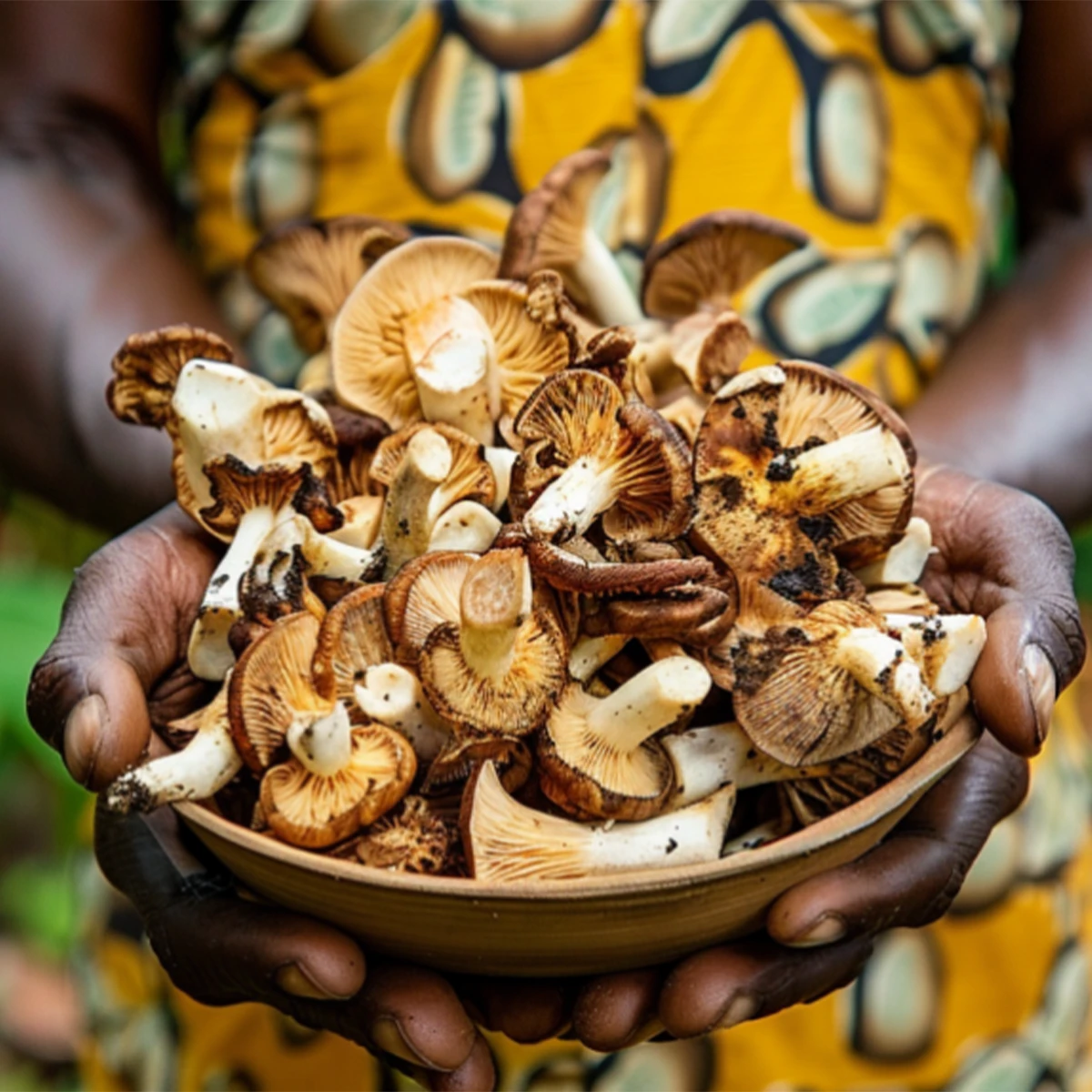
The reasons for this gap in research are complex, structural, and not easily resolved. Collecting and exporting biological specimens is tightly regulated across much of southern Africa. Sequencing infrastructure is limited, and samples often need to travel to foreign institutions to be analyzed. The density of trained mycologists relative to available habitat is low. Sustained scientific fieldwork requires institutional conditions and funding that are not always present.
Dr. Cathy Sharp at the Natural History Museum of Zimbabwe collected some of the first specimens of Psilocybe ochraceocentrata back in 2013. Formally describing what she had found took over a decade and required an international collaboration spanning Clark University, the University of Utah, Duke University, and the Natural History Museum of Zimbabwe. That is less of a reflection of anyone’s shortcomings as it is an honest portrait of how slowly this kind of science moves, and how much remains undocumented.
The implication is that African Psilocybe diversity is almost certainly far richer than the current record reflects. More species are waiting to be found and described, and lucky for us microscopy enthusiasts, the work is just getting started.
Why One Specimen Is Never the Whole Story
The paper’s morphological findings are worth noting for anyone with a serious interest in spore examination. The holotype of P. ochraceocentrata showed no pleurocystidia or cheilocystidia, the microscopic structures on gill surfaces and gill edges that taxonomists rely on for identification. Yet two other specimens in the study showed clear cheilocystidia. Spore dimensions also varied considerably across collections, with the type specimen producing notably smaller spores than some of the other material examined.
This variability illustrates something important about how species descriptions work and their limitations. A description built from a handful of specimens may not capture the full range of variation within a species. Features that appear diagnostic in one collection may be absent in another. What you see in a single specimen is not necessarily representative of the species as a whole.
What the Paper Settles — and What It Doesn’t
The practical upshot of the paper is straightforward. Psilocybe ochraceocentrata is a formally described species, anchored to a type specimen held at a natural history museum, supported by peer-reviewed molecular and morphological analysis, and published in one of the more respected journals in biology. What has been circulating as natalensis, Natal Super Strain, and Transkei has a correct name now, and that name is P. ochraceocentrata.
There are downstream implications worth watching. Regulatory frameworks for psilocybin research increasingly specify particular species by name. As the taxonomy of this genus gets more precisely resolved, the gap between what legal documents say and what the science actually reflects will need to be addressed. That conversation is already beginning.
Beyond the regulatory angle, this paper is a useful reminder that the mycological record is still very much being written. A species that turns out to be genetically distinct from anything previously described was circulating widely in scientific and enthusiast communities for years without anyone realizing it. The names we use shape what we think we know, and the names, as this paper makes clear, are not always correct.
The full paper is available in Proceedings of the Royal Society B for anyone who wants to engage with the primary evidence. Given how much remains unknown about this genus, it is unlikely to be the last word on any of these questions.